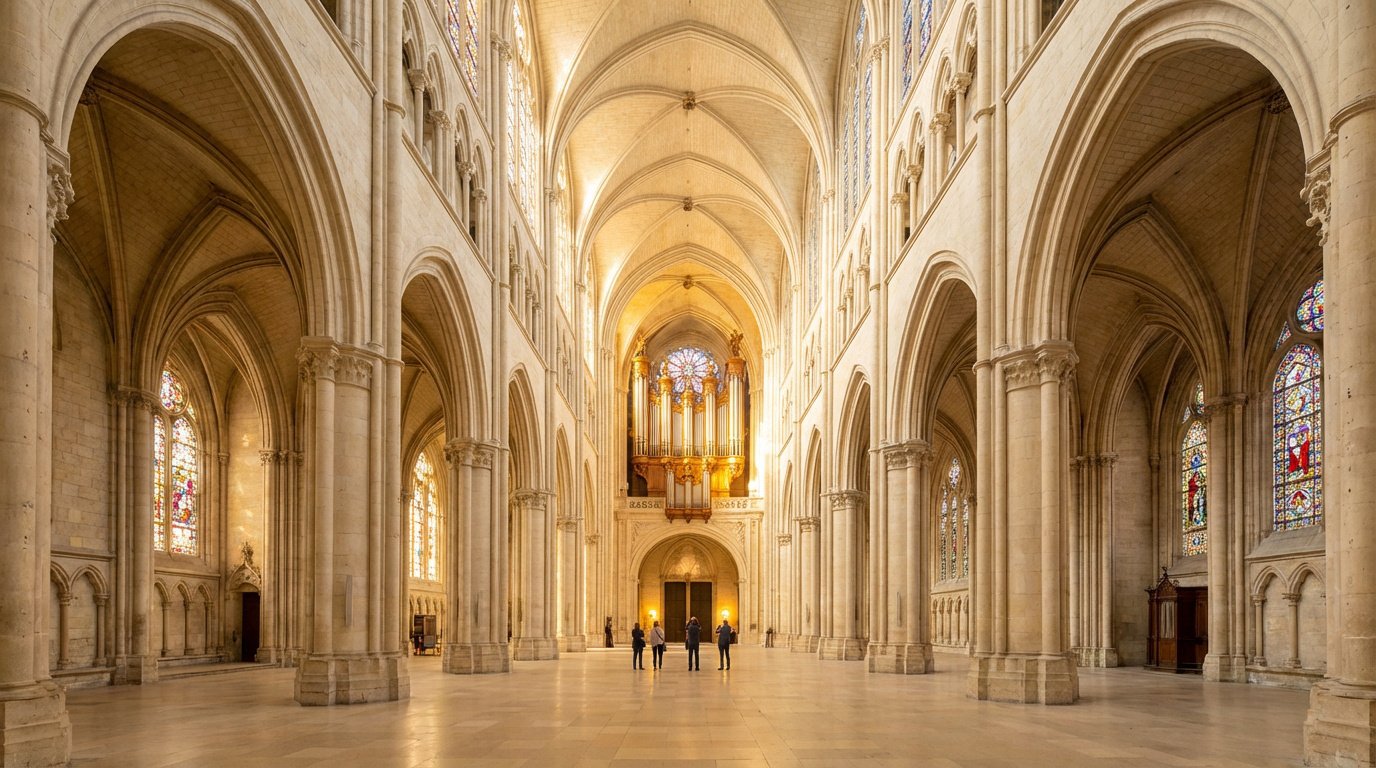
Are you dreading the thought of navigating the post-restoration crowds only to find a dark, soot-stained sanctuary? My guide to the new inside notre dame paris reveals how a revolutionary latex cleaning technique has finally exposed the radiant blond Lutetian limestone hidden for decades. You will discover the exact strategy to bypass the chaos and witness the breathtaking verticality of the reconstructed nave, now illuminated by 2,000 smart LED projectors and perfectly restored 13th-century rose windows.
The Visual Transformation Of The Blond Limestone Interior
While the 2019 fire left a heavy emotional scar on Paris, the sight greeting you inside Notre Dame today is nothing short of a rebirth. The darkness has vanished, replaced by a brightness that feels almost supernatural.
Radiance of the deep-cleaned medieval walls
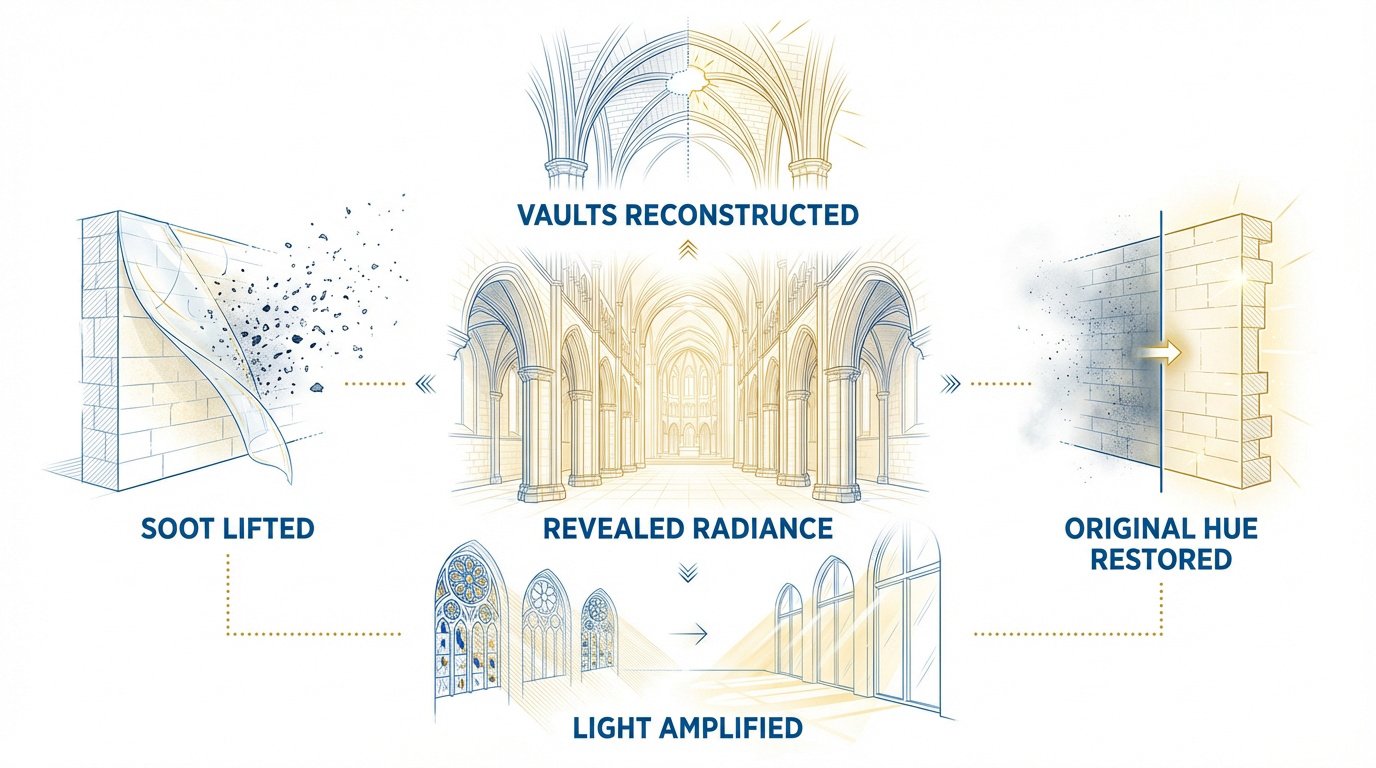
Restorers used a clever latex film to lift years of toxic soot. This spray-on technique trapped lead dust without hurting the fragile stone. It was a silent, dust-free victory for the heritage teams.
The result is a shock. The Lutetian limestone now glows in its original blond hue, far from the pre-fire gray grime. People actually thought that dirt was the stone’s natural color; they were wrong.
Walking through the nave now feels like stepping into the 12th century. The luminosity has completely shifted the atmosphere of the space. You can see the restored interior of Notre-Dame in all its pale, medieval glory.
Reconstructed vaults and the end of structural scars
Masons have finally finished the stone vaults that collapsed during the blaze. Matching new stones with the original medieval blocks was a massive technical challenge. They succeeded brilliantly.
The integration is totally seamless across the ceiling. You won’t find any fire scars left behind today. It honestly looks as if the disaster never even occurred.
The perfect Gothic proportions are back in the nave and transept. Seeing that terrifying « hole in the sky » finally closed is a huge relief. The geometry is once again flawless.
« The restoration has transformed the interior from a dark, dusty space into a glowing hall of light, returning the stones to their pale white glory. »
Light filtration through restored and contemporary windows
Cleaning the high windows has made a world of difference. While the 13th-century rose windows were carefully preserved, the surrounding glass is clearer. Natural light pours in like never before.
This light hits the blond walls and creates a striking effect. The colors of the interior paintings now look much more vivid. It is a literal enlightenment for the eyes.
There is still a debate about adding contemporary stained-glass windows. The classics remain the heart of the building, but modern touches are being considered. This balance keeps the cathedral alive.
3 Specialized Techniques That Saved The Cathedral Walls
The visual transformation of the interior is staggering, but the real magic happened through grit and silent science. Let’s look at the « behind-the-scenes » expertise that made this cleanup possible without breaking a single medieval stone.
Latex nebulization for delicate stone preservation
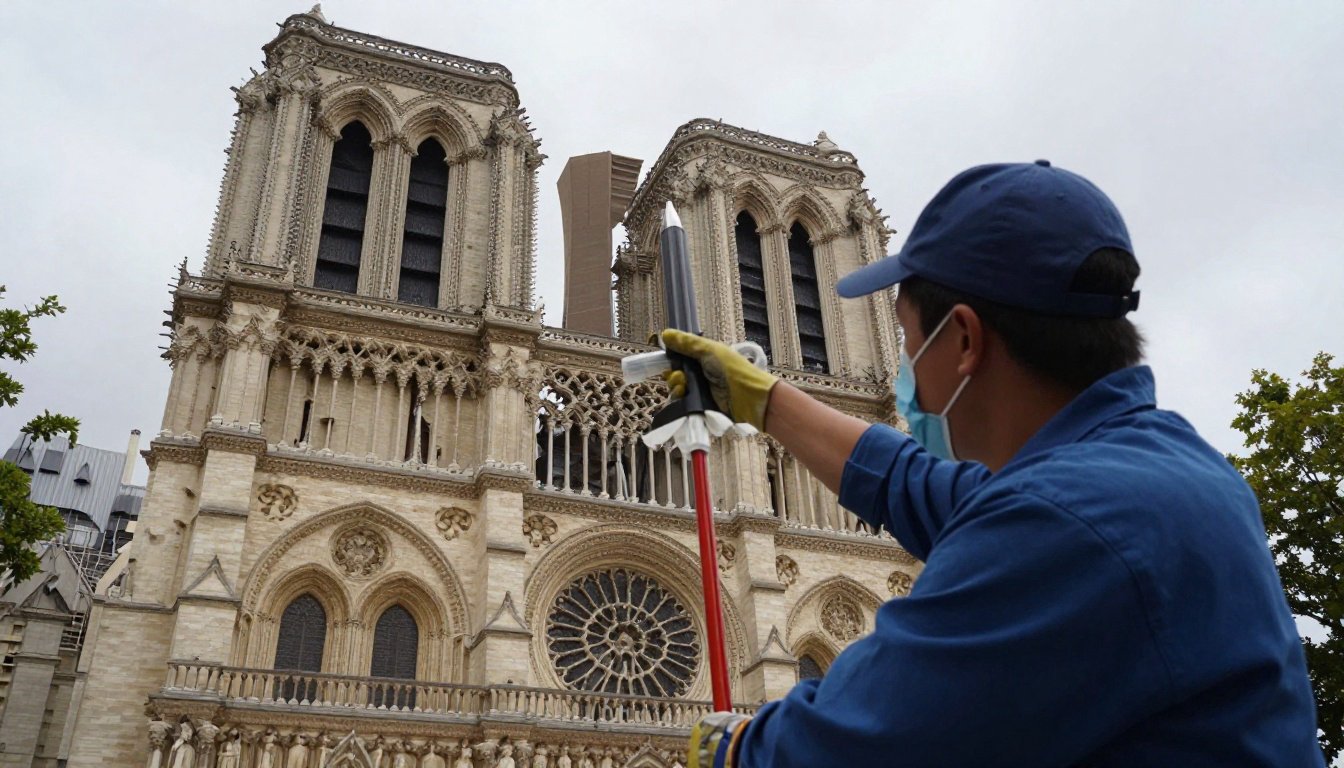
Restorers sprayed a specific latex paste onto the interior stone. This film trapped lead micro-particles and soot without any aggressive scrubbing. It was the only way to save fragile carvings.
Expert teams then literally peeled this « skin » off the walls. Watching the dark grime come away in sheets is satisfying but tedious. It requires incredible patience from the specialized technicians involved.
This method easily beats traditional abrasive cleaning. Sandblasting would have ruined the fine 12th-century details forever. Latex is gentle, precise, and highly effective for deep lead decontamination inside Notre Dame Paris.
Structural consolidation of the fire-weakened masonry
Engineers injected specialized mortars into heat-damaged pillars. The extreme fire made some ancient stones as crumbly as biscuits. They required immediate internal reinforcement to prevent a collapse.
Stonemasons also replaced calcined blocks in the high galleries. They used traditional hand tools to match the original 12th-century craftsmanship perfectly. It is a brilliant mix of old and new.
Monitoring the flying buttresses remained the top priority. These external « arms » hold the massive walls up. Their stability was our biggest worry during the first two years of the project.
Micro-desalination of the centuries-old mortar joints
Fire-fighting water pushed harmful salts deep into the masonry. If left alone, these salts would cause the walls to flake and rot. We had to extract them using specific absorbent compresses.
We used lime-based materials for authenticity instead of modern cement. Cement is far too rigid for medieval structures. Lime allows the 800-year-old building to « breathe » as it always has.
Damaging the original 12th-century core was never an option. This is surgical work performed on a massive, cathedral-sized scale. Precision was the only rule for these expert restorers.
| Technique | Primary Goal | Key Material Used |
|---|---|---|
| Latex Cleaning | Lead and soot removal | Latex film |
| Grout Injection | Structural consolidation | Lime mortar |
| Desalination | Salt removal from joints | Lime-based materials |
How Did The Great Organ Survive The 2019 Heat?
While the stone vaults of the nave held firm, the « voice » of the cathedral faced a silent, microscopic enemy. The Great Organ, perched under the western rose window, miraculously escaped the flames but not the aftermath.
The Great Organ features 8,000 pipes. Though untouched by fire, it was coated in toxic lead dust. Cleaning required total dismantling and transport to specialized workshops across France.
After securing the structure, experts shifted focus to the legendary Great Organ to ensure its complex mechanics would sing again for the 2024 reopening.
Dismantling and cleaning the 8,000 pipes
The logistical effort was truly massive. Every single pipe required careful removal. It was like a giant, toxic 3D puzzle.
Lead dust removal was the priority. The fire coated the internal mechanisms in poison. Cleaning them required specialized workshops across France.
Artisans spent years scrubbing and repairing the metal and wood. The organ didn’t burn, but the dust was a silent killer. This restoration ensures a powerful Notre Dame de Paris – Acte 2, Chanson 24 : Le Final for future visitors.
Reassembly and the delicate voicing process
The tuning process is incredibly specific. The cathedral’s acoustics have changed because the walls are cleaner. The organ needs to be « re-voiced » for this new environment.
Clean stone reflects sound differently than soot-covered stone. This creates a technical nightmare for the tuners. They must adapt to the new resonance of the nave.
The 18th-century console restoration is where the magic happens. Bringing this complex machine back to life is the ultimate tribute to French music. Consult the official site of Notre-Dame de Paris for more history.
Return of the Crown of Thorns and liturgical relics
New secure display cases now protect the relics. The Crown of Thorns needs protection and visibility. The design is modern but respects the sacred.
The Viollet-le-Duc reliquaries are back home. These 19th-century treasures were saved by a human chain. Now they return to their rightful place in the treasury.
The return of these items marks the spiritual reopening. It’s not just a museum; it’s a living place of worship. You will find these sacred items on display:
- The Crown of Thorns
- The Tunic of Saint Louis
- Pieces of the True Cross
- The restored 19th-century reliquaries
Gothic Geometry Of The Nave And Double Ambulatory
Now that the treasures are back, let’s look at the architectural skeleton that holds it all together.
Verticality and the three-level elevation system
To truly feel the 33-meter height, stand exactly where the first two massive bays meet the lighter nave. It’s a masterclass in structural transition.
The nave creates a rigorous architectural rhythm. Arcades, tribunes, and high windows draw your eyes upward. This classic early Gothic design defines the entire internal atmosphere.
Notice the clever transition in the pillars. They start massive at the base for support. Then, they become slender at the top to mimic a reach toward heaven.
During the 13th century, architects modified the original four levels. They enlarged the windows to capture more light. Restorers have perfectly respected these historical layers during the recent works.
Sexpartite Vault: A rib vault divided into six sections by diagonal and transverse ribs, visible throughout the 60-meter long nave.
Unique circulation within the double side aisles
The rare double ambulatory is a functional masterpiece. It allows smooth movement around the choir. This design was essential for medieval pilgrims visiting the relics.
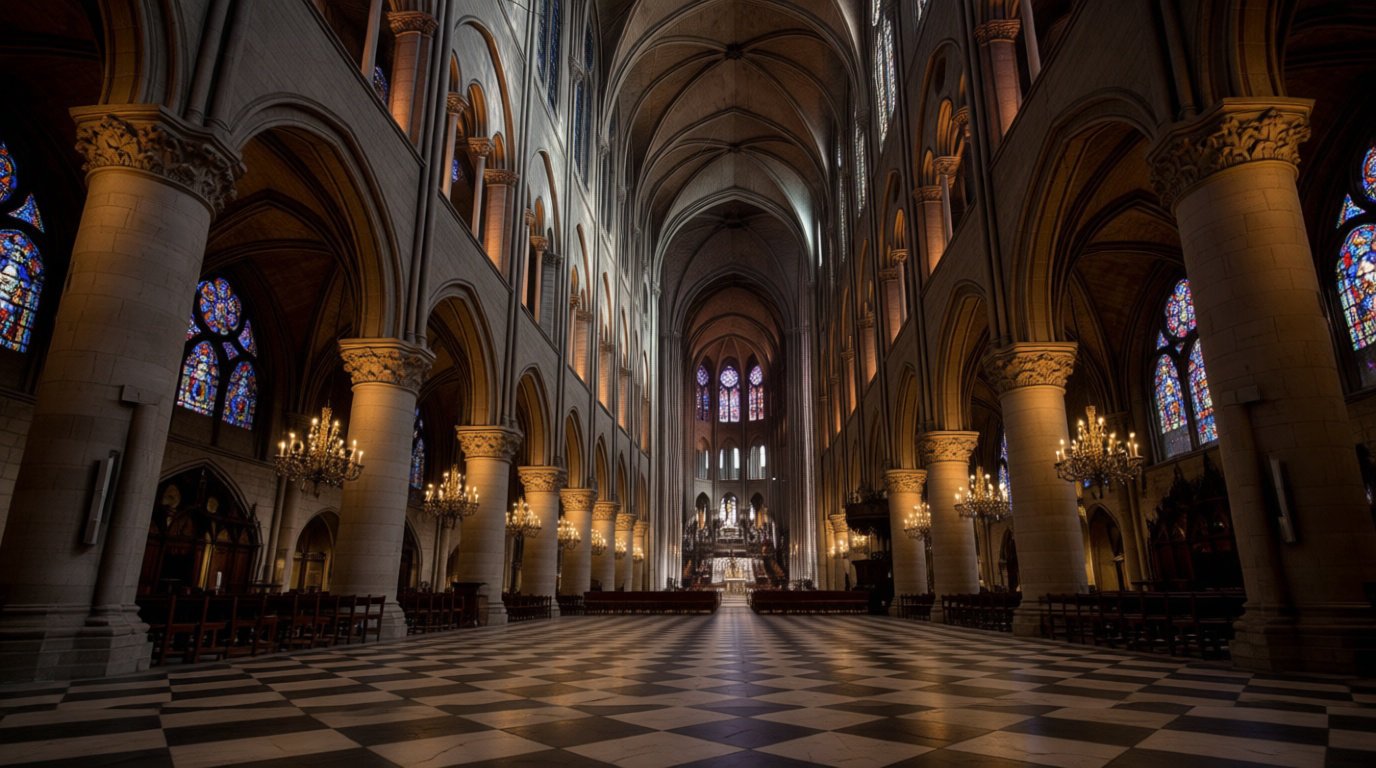
Twenty-nine chapels line the outer walls today. They act like small private sanctuaries for reflection. Each space holds its own unique history and specific art pieces.
These aisles serve both tourists and those seeking quiet. The double row of columns creates a sense of infinite space. You can explore this layout further in our guide to Notre-Dame de Paris : Histoire et Incendie du 15 Avril 2019.
Transept roses and the persistence of medieval glass
The survival of the North and South roses is miraculous. Intense heat threatened the structure in 2019, yet the glass held. It remains a triumph of medieval engineering.
Massive stone tracery supports these 13-meter diameter « wheels. » These stone structures are true masterpieces of 13th-century geometry. They provide the necessary strength to hold the ancient lead.
The windows function as a « poor man’s Bible. » They tell vibrant stories of saints and biblical events. The North rose specifically retains its original glass from the 1200s.
| Feature | Dimension / Fact |
|---|---|
| Nave Height | 33 Meters |
| Total Length | 128 Meters |
| Rose Diameter | Over 9.7 Meters (32 ft) |
2,000 Oak Trees And The Replica Of The Spire
Beyond the stone and glass lies the « Forest »—the massive wooden heart of the roof.
2,000 royal oaks sourced from 250 French forests. 96 meters for the reconstructed spire height. 1,000 years of estimated structural longevity.
Sustainable sourcing from French national forests
Expert foresters selected 2,000 oaks across France. These « royal » specimens were chosen for being perfectly tall and straight. They represent only 0.2% of the annual French oak harvest.
Tradition dictates that you cannot rush 800-year-old techniques. The wood for the spire seasoned for 18 months before carving. This meticulous drying ensures the timber remains stable for centuries.
Harvesting was done sustainably across 250 national forests to maintain ecological balance. It is a massive gift from the French landscape to its monument. You can find more scientific analysis of the oak beams by CNRS.
Hand-hewn beams using medieval carpentry tools
Carpenters used manual axes instead of modern saws. Saws cut through the grain, but axes follow the natural fiber. This specific technique makes the beams significantly stronger and durable.
The ‘Charpentiers sans frontières’ artisans revived these lost medieval skills. This project served as a real-world school of ancient knowledge. They proved that 13th-century methods still beat modern industrial shortcuts.
Hand-hewn wood lasts longer because it respects the tree’s natural integrity. It is a 1,000-year structural solution, not a quick temporary fix. This ensures the roof survives long after we are gone.
« Carpenters used traditional axes to follow the natural grain of the 2,000 oaks, ensuring the new ‘Forest’ roof lasts for centuries. »
Viollet-le-Duc’s spire reborn with modern safety
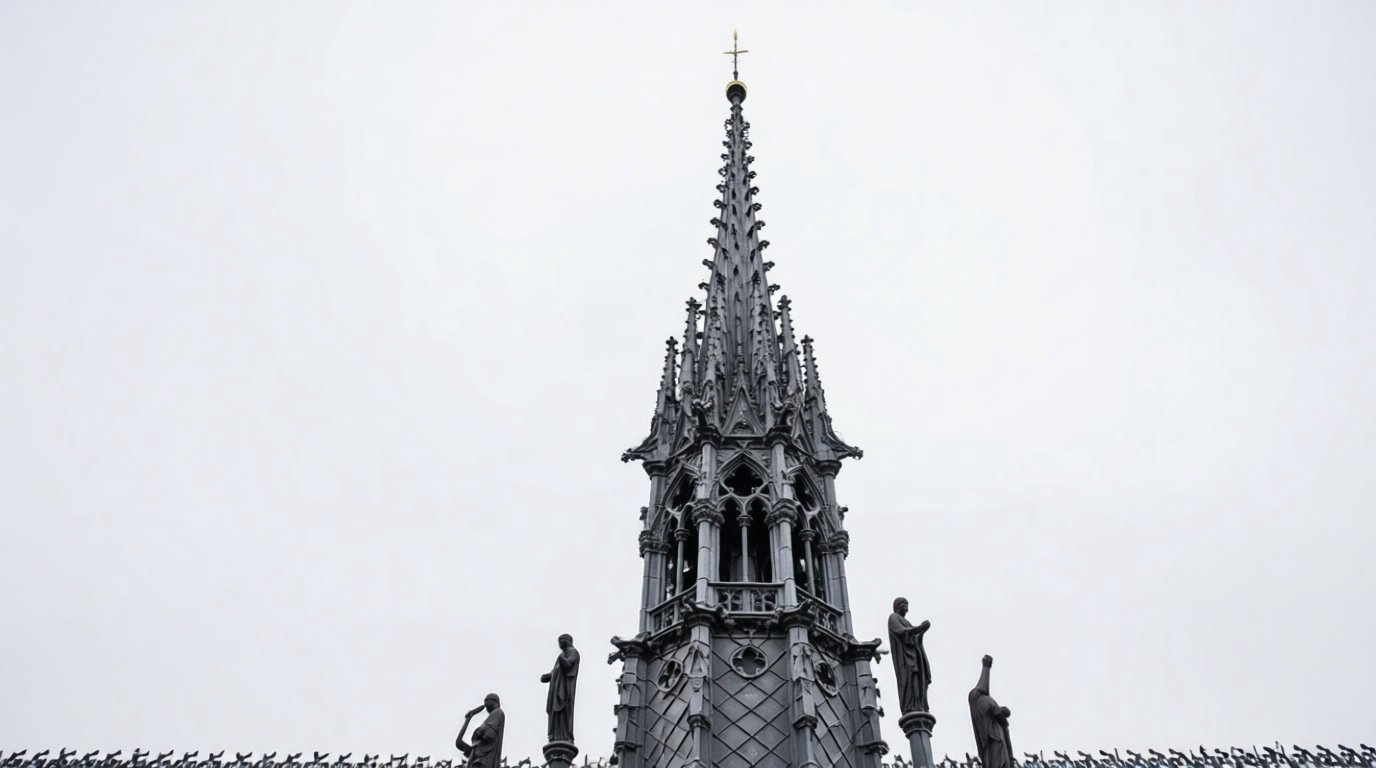
The 96-meter spire reconstruction follows the 1859 plans exactly. Every detail of the lead and wood is a perfect replica. It stands once again as the crown of the inside notre dame paris skyline.
A new copper rooster now sits at the very top. It contains sacred relics recovered from the 2019 debris. It serves as a powerful symbol of the cathedral’s total resurrection.
While it looks medieval, it is packed with fire-mist systems. We have installed over 300 detection points to prevent another disaster. Read more about the Incendie de Notre-Dame | Chronologie et causes 2026.
Practical Logistics For A Seamless 2026 Entry
Planning a visit to this restored masterpiece requires a bit of modern strategy.
Booking your mandatory time slot online
Entry remains free, but you must book a specific time slot online. This mandatory system is the only way to access the monument. It manages the massive 2026 crowds.
Early morning or late afternoon is best for your visit. Midday on the Parvis is often the most congested time. Plan around these peaks to save significant stress.
Use the official app to manage your digital ticket and entry. Avoid paper for a smoother process at the gates. Check Notre-Dame Paris tickets – Free entry guide 2026 | Pro for details.
Security checks and entry procedures at the portal
Large bags are strictly forbidden for safety reasons within the cathedral. Travel light to speed up the security check. This keeps the queue moving for everyone.
You enter through the majestic West portals to begin your visit. This grand entrance highlights the verticality of the restored nave. It sets a solemn, historic mood.
If you arrive early, grab a coffee at a nearby café. The Île de la Cité has some hidden gems. It is my favorite way to wait.
- Mandatory online booking
- Free entry for all
- Strict baggage limits
- Prohibited items like sharp objects
Accessibility and tour duration for smart travelers
New accessibility features like ramps and elevators are now integrated. Everyone can finally enjoy the full beauty of the nave. It is a major improvement.
Plan for at least 90 minutes to explore the site properly. You will need time for the choir and treasury. Don’t rush through these sacred spaces.
The reopening has revitalized the Île de la Cité district. The area is vibrant and full of life again. Learn How to get your Notre Dame tickets for free in 2026 before you arrive.
The restoration has successfully revived the blond Lutetian limestone and the 8,000-pipe Great Organ, ensuring the cathedral’s Gothic geometry shines once more. To experience this transformation, book your mandatory free time slot online before visiting. Your journey inside Notre Dame Paris will be a breathtaking encounter with living history reborn.
FAQ
What does the restored interior of Notre-Dame look like now?
The transformation is truly breathtaking. After a meticulous cleaning process using latex film nebulization, the soot and grime from the 2019 fire have been lifted to reveal the original blond Lutetian limestone. The interior has shifted from a dark, dusty space into a glowing hall of light, returning the stones to their pale white glory.
You will notice that the 12th-century walls and the reconstructed 13th-century sexpartite vaults now possess a radiance that hasn’t been seen in centuries. This luminosity, combined with the cleaned stained-glass windows, creates a sensory experience that feels like stepping directly back into the Middle Ages.
How were the damaged stone vaults of the cathedral repaired?
The reconstruction was a technical feat of Gothic geometry. Following the collapse of parts of the ceiling during the fire, master stonemasons worked to match new stones perfectly with the surviving medieval masonry. By April 2023, the large breach in the nave vault was officially closed, leaving a seamless finish where the structural scars of the disaster are no longer visible.
To ensure the building’s longevity, experts injected specialized lime-based mortars into heat-weakened pillars. Unlike modern cement, this traditional material allows the 800-year-old stone to « breathe, » ensuring the structural integrity of the nave and the double ambulatory for future generations.
Did the Great Organ survive the fire and can it still be played?
The Great Organ survived the flames, but it faced a silent killer: toxic lead dust. To save it, all 8,000 pipes had to be dismantled and sent to specialized workshops across France for decontamination. This massive « 3D puzzle » required years of manual scrubbing to remove the poisonous coating without damaging the delicate metal and wood.
As of 2026, the organ has been reassembled in its 18th-century console. Because the cleaned stone walls reflect sound differently, the instrument has undergone a complex « re-voicing » process. This ensures that its music harmonizes perfectly with the cathedral’s new, brighter acoustics.
Is the Crown of Thorns back inside Notre-Dame?
Yes, the Crown of Thorns and other priceless liturgical relics have returned to their spiritual home. These treasures, including the Tunic of Saint Louis and pieces of the True Cross, are now housed in new, secure display cases that offer both protection and better visibility for visitors.
The return of these items, many of which were saved by a human chain during the fire, marks the official spiritual reopening of the cathedral. They are displayed alongside the restored 19th-century Viollet-le-Duc reliquaries, signifying that Notre-Dame remains a living place of worship rather than just a museum.
How was the « Forest » roof and the spire rebuilt?
The wooden heart of the cathedral, known as « The Forest, » was reconstructed using 2,000 oak trees sourced sustainably from French national forests. To respect 13th-century craftsmanship, carpenters used hand-axes to hew the beams. This technique follows the natural grain of the wood, making the structure significantly stronger than if it were cut with modern saws.
The 96-meter spire is an exact replica of the 1859 design by Viollet-le-Duc. While it looks identical to the original, it is now equipped with a modern fire-mist protection system. A new copper rooster, containing relics found in the 2019 rubble, now sits atop the spire as a symbol of resurrection.
Do I need a ticket to see the inside of Notre-Dame in 2026?
Entry to the cathedral remains free for everyone, but you must plan ahead. Due to the massive crowds expected for the reopening, a mandatory online reservation system. You will need to book a specific time slot via the official app to manage the flow of visitors and ensure a smooth entry through the West portals.
My advice is to book as early as possible and travel light. There are strict baggage limits and security checks at the entrance. If you arrive early for your slot, I recommend grabbing a coffee at a nearby café on the Île de la Cité to soak in the atmosphere of the revitalized district.